Recently I helped my wife, Kasia, prepare a new version of her CV. At first I assumed the task would mostly involve fixing the language, organizing the content, and giving the document a more professional look.
It quickly turned out, however, that the most important change had nothing to do with formatting — it was about how she looked at her own experience.
From a List of Duties to a Description of Real Responsibility
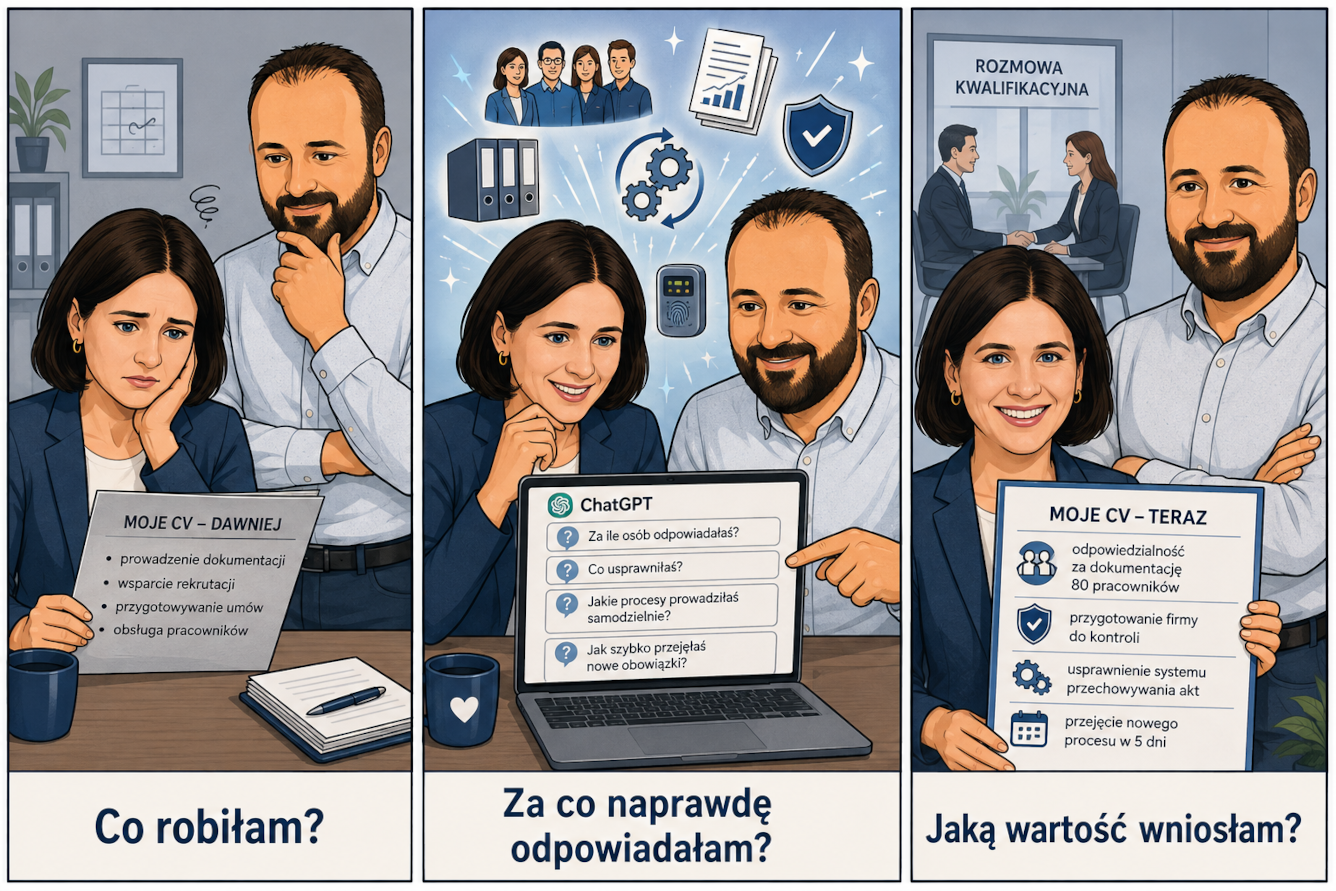
Kasia’s original CV looked fairly typical. It included bullet points such as:
- maintaining documentation,
- preparing contracts,
- supporting recruitment,
- collaborating with the payroll department.
Everything was accurate, but it said very little about the actual level of responsibility. A recruiter could see what tasks Kasia performed, but not necessarily understand their scale or their significance to the company.
So I asked ChatGPT to look at the CV differently: not as a list of duties, but as a record of responsibility, independence, organizational impact, cross-departmental collaboration, compliance, and process improvements.
That was the moment the document really started to change.
The Same Fact, a Completely Different Message
A good example was the note about maintaining personnel files.
In the original CV, it read like a standard administrative task. Only through further questions did it become clear that Kasia was responsible for the completeness of the documentation, prepared the organization for audits, and improved the way the files were stored.
She created an electronic register that made it easier to search for documents and verify their contents.
So this wasn’t just “handling documentation” — it was genuine responsibility for order, compliance, and process efficiency.
The same was true of employee support.
After further clarification, it turned out Kasia was the HR point of contact for around 80 employees and associates. She answered questions about leave, pay, working time, and documents, and supported managers on personnel matters.
The third example was the most interesting to me.
Within five days, Kasia took over management of the access control system. She had to quickly learn to manage access passes, respond to issues, and prepare reports.
In an ordinary CV, details like this easily get lost among many bullet points. Yet they demonstrate initiative, adaptability, fast learning, and a readiness to take on responsibility.
The Questions Mattered Most
The greatest value of working with ChatGPT wasn’t the automatic generation of more polished sentences. What mattered most were the questions.
How many employees did her support cover? How many recruitment processes ran at the same time? What did collaboration with payroll actually look like? Did Kasia help prepare the company for audits?
The answers helped the AI better understand her professional profile — but the same process helped us too.
I could see that Kasia’s work was far broader and more responsible than the document suggested.
She, in turn, began to see her own experience not as a set of daily tasks, but as real responsibility for processes that mattered to the whole organization.
That, I think, was the most important outcome of the whole exercise.
The new CV wasn’t the product of inventing fake achievements. It was the product of better understanding what had actually been accomplished.
Several Versions of the Same Experience
Based on the information we gathered, we prepared a few different documents.
One was a simple version optimized for ATS systems, meant for applying through recruitment portals.
The other was a more traditional, visually appealing CV, better suited for sending directly to a recruiter or hiring manager.
Both present the same facts. They differ only in how the information is presented.
The ATS version is designed to be easily read by a recruitment system. The traditional version is designed to make a better first impression on a human reader.
The Most Interesting Document Wasn’t the CV
The most valuable outcome of the whole process turned out to be a separate document: one designed to prepare Kasia for a job interview.
It includes:
- the key figures and scale of her responsibilities,
- an organized description of her experience,
- examples of improvements and situations requiring independent judgment,
- stories structured using the STAR method,
- answers to common and more difficult interview questions,
- a reminder of how to talk about one’s own work without downplaying its value.
To me, this is the most interesting tool of all.
A good CV can get you invited to an interview, but it won’t automatically make a candidate able to talk about their experience persuasively.
Many people do valuable work but describe it too modestly during interviews:
“I helped out,” “I dealt with documents,” “I made reports,” “I handled the employees.”
The interview-prep document helps turn statements like these into something more precise — and still completely true:
“I was responsible for the completeness of the documentation,” “I prepared the organization for audits,” “I ran several recruitment processes simultaneously,” “I improved how the files were stored,” “I took over a new process in a very short time.”
It’s not about memorizing answers. It’s about reminding yourself, before the interview, of the full scope of your own experience — and walking into the meeting with an organized story about your work.
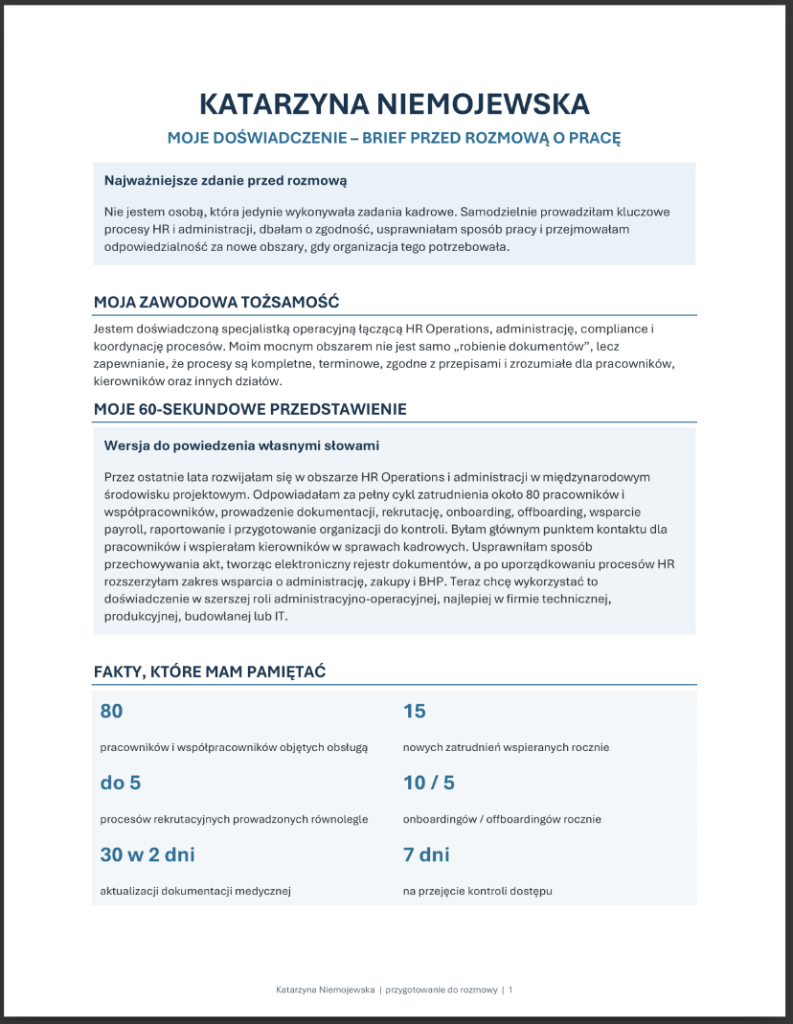
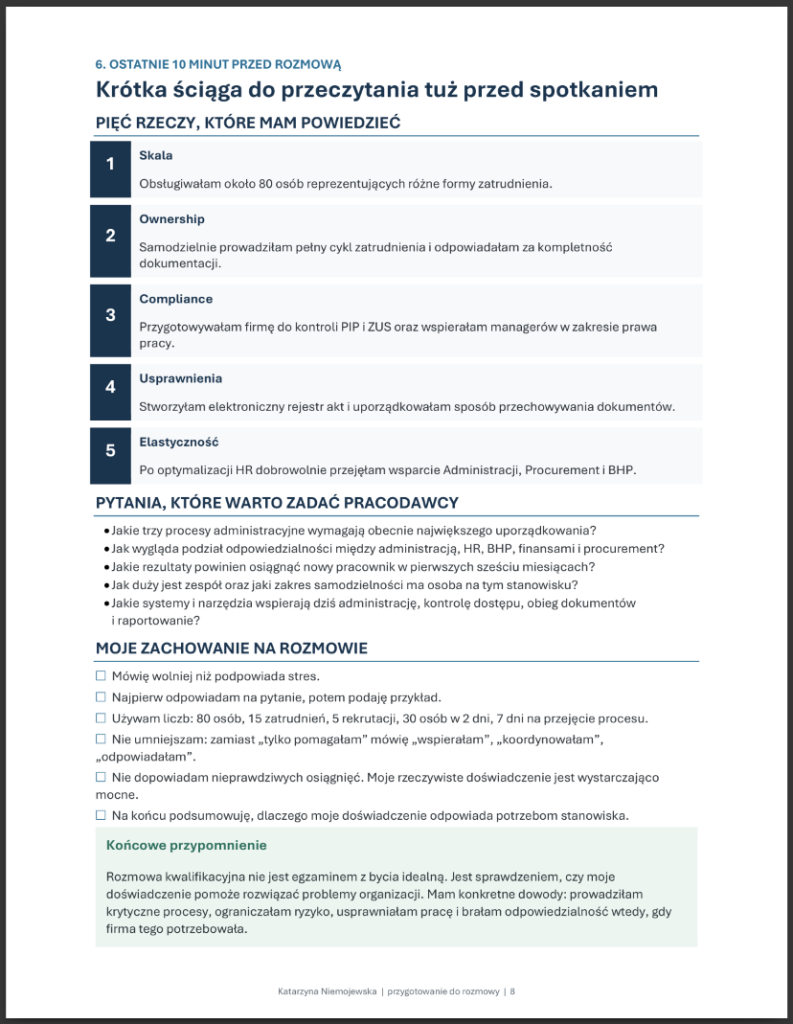
I think this material will do the most to help Kasia present herself well. It will help her talk about her achievements concretely, without artificiality and without unnecessarily downplaying her own role.
AI as a Tool for Better Understanding One’s Own Experience
After going through this process, I can see that ChatGPT can be useful for more than just generating text.
It can act as an analyst — one that reads a document, notices what’s left unsaid, asks questions, and helps put a name to responsibility, scale, and results.
There’s one condition: the AI shouldn’t invent achievements.
A good CV should present real experience in a way that makes its value clear.
In our case, a process that started with editing a CV ended with a much better understanding of Kasia’s professional profile — by the AI, by me, but above all, by her.